
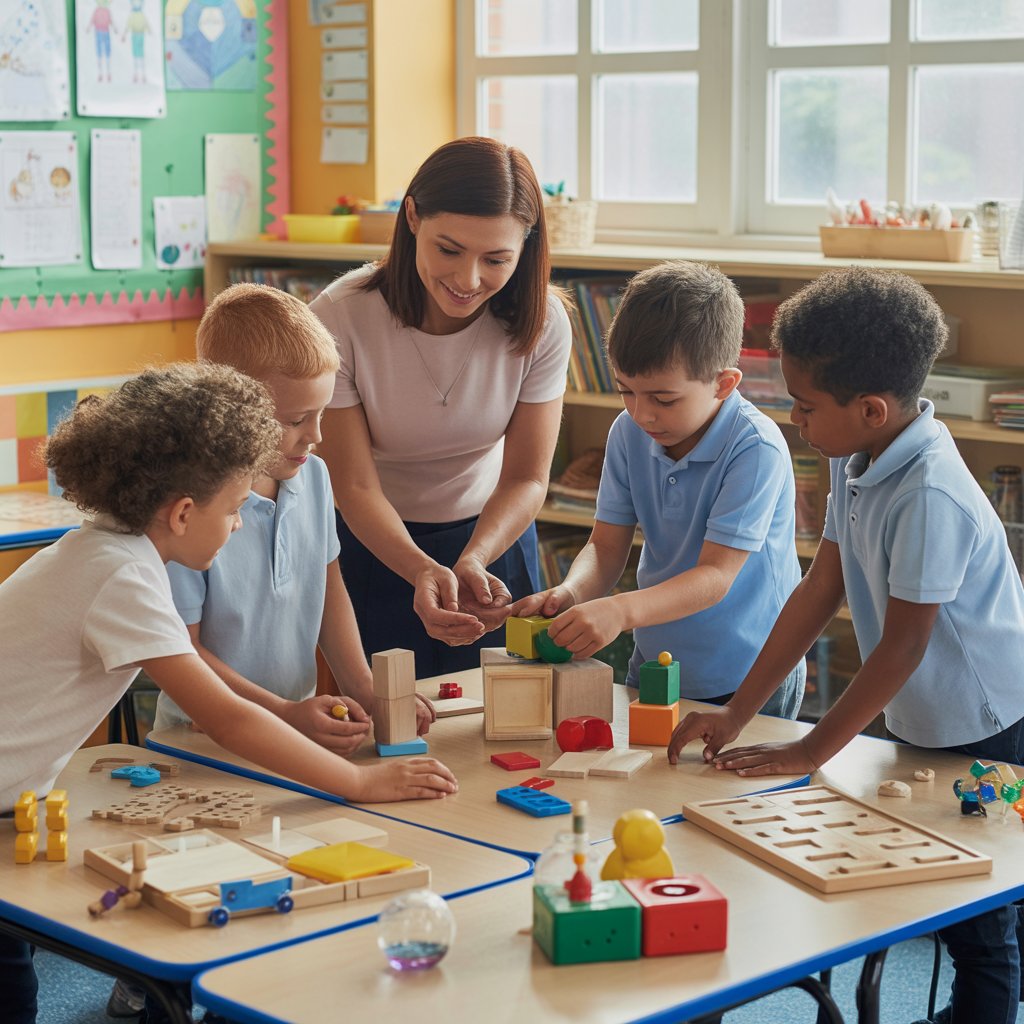
How Teachers Foster Problem-Solving in Young People
At all ages, children face puzzles to challenge their agility, reason, and capacity for thinking outside the box. But the world today operates at a greater pace, and problems become more complicated quickly. What students are supposed to learn is not only to remember but also how to interpret, question, and apply information to contexts they haven’t seen before. Whether the child ends up as a police officer in the UK, an engineer in India, a designer in Germany, or an entrepreneur in the US, is there any skill that will be common for all those tasks, and that is solving problems?
The ability is not developed overnight. It grows, over time, from little things and the influence of great teachers. Behind every child who believes in himself or herself, who learns to think and wield standard English as a sword, there is frequently an adult, a teacher who offered that first affirmation or spelled out how to pronounce misguided phonics. Schools can teach subjects, but teachers are the ones who teach children to think.
Critical thinking is not just an academic skill. It’s a life skill, one that helps young people navigate relationships and manage stress and adapt to the unpredictable so they can grow into capable adults who foster strong families, meaningful careers, and effective citizenship in their communities. Understanding how teachers purposefully develop this skill among students reminds us of the deep and lasting work that occurs beyond textbooks and tests.
- Why Problem-Solving Matters Today
Learning has never been just about regurgitating information. Ruling, outlining, cuing: None of these fluency strategies makes students better readers. Students do not read because they want to race through paragraphs; they read to understand ideas, weigh evidence, consider perspectives, and reach informed conclusions. The goal of education is to help make thinking visible and become better at decoding the world and responding with clarity and creativity.
But what is learning other than solving problems? By becoming critical thinkers, students learned:
- Navigate real-life problems with confidence
- Form opinions of their own, instead of taking in opinions from the outside
- Work well with diverse peers
- Cope with changing environments and tasks, new problems, or situations.
- Think before you act, not the other way around.
These abilities determine not only academic achievement but personal resilience. The child who learns to question, reflect, and reason will become the adult who can weigh risks, juggle duties, and operate effectively in a complex world.
What makes great teachers great is that they don’t just provide answers. They are sherpa, guiding students to forge their own paths. They don’t tell students what to think; they teach them how to think.
- How Teachers Encourage Problem-Solving
Strong thinkers do not just spring upon us by happenstance. Teachers design learning opportunities that intentionally confront students’ assumptions, broaden their perspectives, and make them more comfortable with questioning uncertainty. The following are some of the key ways teachers help children develop these skills, not as discrete manoeuvres but bound up in a broader approach to education.
- Asking Open-Ended Questions
Open-ended questions are one of the best tools that a teacher has. Some questions don’t have an answer out there, a single correct answer out there, but rather require reasoning as opposed to collecting:
- “How could we solve this?”
- “What might be causing this?”
- “Can you imagine a different way around it?”
Such questions convey the message to students that learning is not striving for perfection or regurgitation; it’s about thought. Inquiry-based questions help create classrooms where students thrive because students feel safe enough to share ideas, take intellectual risks, and think aloud without fearing ridicule or embarrassment.
This approach fundamentally shifts the student-teacher relationship. Rather than passively receiving information, students and teachers become active creators of knowledge. They learn to slow down, reflect , and analyse key attributes of any potential professional or leader.
- Using Real-Life Examples
Real-life case studies move learning out of the abstract and into a context that students can understand. On the other hand, if educators can make explicit the links between their ideas and students, they can have practical tools that contribute to a sense of purpose and relevance.
For example, the placement of this household machine or a more familiar piece of equipment, like a tractor, helps students grasp concepts such as design, engineering, problem-solving, and cause-and-effect relationships. Someone saw a problem and invented a solution, an invention known as the tractor. What I like about this cross-pollination is that students are exposed to the idea that problem solving is not just something they do in school: it is at the core of any innovation across all disciplines.”
Specific comparisons ground learning experiences that are easier to understand and more powerful. Students start to recognise that every toy and tool, and improvement of their environment, is an answer to a genuine problem someone, somewhere, once faced.
- Group Activities and Collaborative Learning
Teamwork is not just a social activity. It represents a training ground for the mind in which students hone their abilities to express ideas, reconcile differences, and weld widely varying perspectives into mutually acceptable solutions. Group work forces students to listen, question, compromise, and cooperate, all skills that will be useful in any field.
In groups, they realise that there are many right ways to tackle the same problem. They see how others think. They come across perspectives they never would have seen. This exposure reinforces their grounding while helping them to mature into empathetic communicators.
Students who work closely with other students develop the teamwork and collaborative skills that college and career readiness require.
- Learning Through Trial and Error
Permission to fail is one of the most transformative gifts that a teacher can bestow. This leads to freedom, a state of mind in which mistakes are seen as chances, not punishable errors. They dare to experiment. They investigate. They take intellectual risks.
Trial and error is not a deficiency; it’s an adventure. When teachers permit experimentation, they build resilience, persistence, and creativity. They learn that solutions are not found on the first try, and being frustrated is not something that stands in opposition to doing the work, but is part of the process.
The result is a generation of kids who are not afraid to take on challenges, kids for whom problems are not threats, but puzzles that beg to be solved.
- Encouraging Reflection
Reflection is the secret weapon of thought. When teachers ask students, without referring to their notes or a book, to pause and reflect on what worked when analysing documents in previous lessons and what didn’t work, they are turning on metacognition, the ability to think about one’s thinking.
Reflection:
- Strengthens memory
- Deepens understanding
- Sharpens awareness of reasoning patterns
- Helps students avoid repeating mistakes
- Instills confidence in dealing with further confrontations
Reflective children are thoughtful, intentional learners who own their growth. They don’t get any better as students because they’re trying harder; it’s because they’re not trying harder.
- Creativity: The Heart of Problem-Solving
Drawing, painting, and creative expression are not the only outlets for our creativity. Creative problem-solving is the capacity to conceive of new angles on challenges, recognise new patterns, and formulate an original solution.
Fostering Creativity Educators foster creativity by encouraging students to:
- Ask questions
- Generate ideas
- Try new methods
- Experiment without judgment
- Think beyond traditional boundaries
Students should be able to innovate when they think creatively. They come to science, math, and technology as well as day-to-day life with open minds ready to learn. A creative person sees opportunities rather than limitations.
When creativity is a habit, problem-solving becomes second nature.
- Problematization as a Factor of Academic Achievement
For students to learn how to break up problems into steps, a process often described as “peeling the onion,” brings powerful academic benefits. They become savvy about negotiating big questions, budgeting time on exams, following logical sequences, and grasping concepts instead of memorising facts.
Teachers who repeatedly ask and encourage problem-solving strategies promote habits of mind that students take with them for the rest of their lives. Not just grades, but personal confidence and emotional stability are tied to such skills.
A child who has learned to reason through complexity becomes an adult who can tolerate uncertainty, assess risks, negotiate ambiguities, and make reasoned choices.
- Building Confident and Independent Learners
Problem-solving doesn’t just engage the mind; it also builds character. When students repeatedly take problems from one step towards a solution, they develop patience, discipline, and calm when the pressure is on. They become people who trust their own judgment and are open to new experiences.
Here, teachers are central agents in the context of:
- Praising effort
- Acknowledging progress
- Creating safe, supportive learning environments
This emotional groundwork enables students to become self-directed learners, people who take charge of their own development, engage with difficulty, and continue even when they find work gruelling.
- Final Thoughts
Problem-solving ability is one of the most beautiful things you can give to children. Under the right mentorship, students evolve into more than just intellectually capable individuals; into independent thinkers who can navigate life with clarity, bravery, and creativity.
Even the most basic of tools, a tractor, for instance, serves as a reminder to students that there are solutions out there in the world waiting to be found for every problem. This is a time when the engineers, designers, leaders, and citizens of tomorrow will need such skills more than ever.
Wherever life leads them, problem-solving skills will form the basis of their success in an ever-changing world.