
Most people struggle with memory, not because they lack intelligence, but because they try to remember details in isolation. Facts fade, lists blur, and entire chapters disappear shortly after reading. The real challenge is not remembering more; it is structuring information in a way the brain is designed to retain.
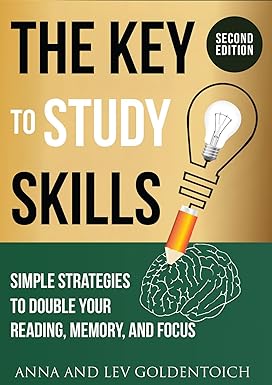
In The Key to Study Skills (2nd Edition): Simple Strategies to Double Your Reading, Memory, and Focus, introduces a powerful system for linking, chunking, and visual structuring that allows you to retain hundreds, or even thousands, of details with accuracy and speed. These techniques form the backbone of the KeyToStudy System, used to dramatically improve reading comprehension, memory, and focus.
This article explores how markers, visualization, chunking, memory palaces, and PAO work together to transform how you remember what you read.
Why Structure Matters More Than Memory
Remembering isolated details is fragile. The brain recalls information best when it is connected, contextual, and meaningful. This is why simply highlighting text or rereading chapters rarely works.
The KeyToStudy approach emphasizes one foundational principle:
All information in the brain is interconnected. Retention improves when new information is attached to existing knowledge.
To achieve this, we use markers (memorable representations of information) and structures (systems that organize those markers).
Linking Markers: Turning Details Into Navigation Paths
Markers are mental placeholders for important ideas. However, markers alone are not enough. To retrieve them later, they must be linked.
Anchors: The Backbone of Recall
Anchors are special markers that help retrieve all others. They are:
- Highly vivid and memorable
- Connected to prior knowledge
- Designed to answer specific retrieval questions
Anchors act as entry points, allowing you to navigate through large amounts of information quickly.
Finding Your Natural Markers
Not everyone visualizes the same way. Effective markers depend on what your brain naturally remembers best.
Ask yourself:
- Do you remember stories better than facts?
- Do jokes, images, equations, or environments stick more easily?
- Do you recall real-life experiences more vividly than movies?
There is no “right” type of marker. What matters is effortless recall. Even unusual or exaggerated imagery works, as long as it is memorable.
Following the Structure of the Text
One of the most common mistakes in memorization is imposing artificial structure onto the text. Instead, the KeyToStudy System emphasizes:
- Following the author’s hierarchy
- Preserving sections, paragraphs, and logical flow
- Matching markers to the natural structure of the material
This ensures faster reading and higher accuracy.
Markers vs. Details: Finding the Right Balance
Effective memorization depends on balance:
- Too many details per marker lead to overload
- Too many markers slow reading and reduce comprehension
A common guideline:
- ~2 markers per paragraph
- ~5 details per marker
Markers provide structure; details provide vividness.
How Markers Are Linked
Markers are linked visually, not verbally. The recommended methods include:
1. Physical Interaction
Objects collide, merge, break, or interact. This creates fast, intuitive links.
2. Cartoon / Storyboarding Method
A sequence of vivid scenes with:
- A consistent mood or setting
- Active characters
- Larger ideas occupy more visual space
- Sections connected by a simple plot
This method boosts creativity while maintaining speed.
3. Hyperlinking
Inspired by websites, this method uses:
- Simple markers
- Dense, complex connections
- Navigation through links rather than stories
It is ideal for learning entire disciplines rather than single articles.
Levels of Visualization
Visualization operates at different depths:
Low-Level Visualization
Simple sequential interactions between objects.
Middle-Level Visualization
Clusters of objects interacting so that removing one breaks the connection.
High-Level Visualization
The learner becomes part of the scene, operating within a fully constructed virtual world capable of holding thousands of details.
High-level visualization enables near-perfect retention but requires practice.
Speeding Up Marker Creation
Visualization is a natural skill. Children use it effortlessly, and adults retain the same ability.
You can speed up marker creation by:
- Practicing free association
- Finding patterns in randomness
- Associating unfamiliar words with familiar sounds or images
The goal is not perfection, but speed and consistency.
Chunking and Sequencing: Expanding Working Memory
Working memory is limited (7 ± 2 items). Chunking increases its capacity by grouping related markers.
Sequencing
Markers are linked in ordered chains, similar to stories or task lists.
Simple Chunking
Groups of 3–5 similar markers are combined into a single unit.
Intermediate Chunking: Data Structures
- Linked lists: Ordered traversal forward and backward
- Trees: Hierarchical structures mirroring text logic
- Maps: Associative links across different domains
These structures allow flexible navigation through information.
Remembering Order Without Losing Flexibility
Different structures support different speeds:
- Linked lists: simple but slow
- Trees: balanced speed and structure
- Graphs: maximum flexibility and complexity
The ideal approach combines:
- Top-down preparation
- Bottom-up detail addition
- Final top-down consolidation
Memory Palaces: Structured Storage at Scale
Memory palaces (loci) are spatial systems with compartments designed for chunking.
Why They Work
- Intuitive organization
- Hierarchical nesting
- Massive capacity
You can build:
- Rooms → houses → cities → worlds → universes
Memory palaces allow millions of details to be stored when used consistently.
Advanced Memory Palace Techniques
- Safe deposit compartments for rapid chunking
- Moving palaces (routes, journeys, timelines)
- Portals and hyperlinks connecting dense information
- Forward and backward traversal to reinforce recall
Memory palaces excel for static, structured information such as:
- Legal texts
- Medical knowledge
- Historical data
- Language systems
PAO: Person–Action–Object for Maximum Compression
PAO is one of the most powerful memory systems available.
How PAO Works
- Each marker consists of a person, an action, and an object
- These elements combine into a single vivid image
- PAO compresses large amounts of data into small visual units
PAO enables:
- Rapid encoding (≈0.5 seconds per marker)
- High accuracy
- Easy integration with memory palaces and chunking
Key guidelines:
- Use distinct actions
- Avoid generic objects
- Keep images bold and visual
- Practice until associations are automatic
Combining Systems for Maximum Retention
The most effective learners do not rely on one method. They combine:
- Markers
- Chunking
- Memory palaces
- PAO
- Hyperlinking
This layered approach creates multiple retrieval paths, making recall faster and more reliable.
Conclusion
Effective memory is not about effort; it is about structure. By linking markers, chunking information, building visual systems, and practicing intentional reading, you can dramatically increase both speed and retention.
Take Your Learning to the Next Level
All of these powerful techniques are explained in detail in The Key to Study Skills (2nd Edition): Simple Strategies to Double Your Reading, Memory, and Focus, a comprehensive guide designed to help learners of all levels read faster, retain more, and focus better. This book transforms overwhelming study material into clear, actionable strategies that you can start applying immediately.
If you want to master these skills step by step, the KeyToStudy: Memory MasterclassKeyToStudy: Memory Masterclass provides guided exercises, structured training, and expert techniques that take you from basic understanding to full mastery. Each lesson is carefully designed to strengthen your memory, improve concentration, and make learning more efficient and enjoyable.
Contact us at info@keytostudy.com today to access exclusive discounts on the KeyToStudy: Memory Masterclass. Whether you want to remember names, numbers, complex texts, or study smarter for exams, this course gives you the tools to achieve faster results with confidence.
Remember, reading faster and remembering more is not a natural talent; it’s a trainable system, and with the right guidance, anyone can harness it. Take the first step now, and transform the way you learn forever.