
For generations, people have been taught that human perception relies on just five senses: sight, hearing, touch, taste, and smell. While this framework is convenient for early education, it fails to reflect the true complexity of human perception. Modern neuroscience shows that human experience is shaped by dozens of overlapping sensory systems, many of which operate quietly in the background yet profoundly influence learning, emotion, memory, and focus.
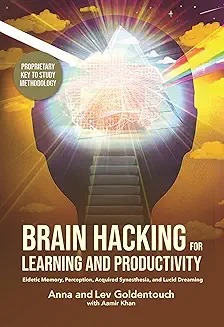
This deeper understanding of perception forms the foundation of the book Brain Hacking for Learning and Productivity: Eidetic Memory, Perception, Acquired Synesthesia, and Lucid Dreaming, which explores how sensory systems can be trained, integrated, and optimized to improve mental performance. By expanding beyond the traditional sensory model, it becomes possible to learn faster, regulate stress more effectively, and engage the world with greater clarity.
This article explores how expanded sensory awareness, sensory fusion, compressed perception, and feedback loops shape cognition, learning, and resilience.
Why Humans Need More Than Five Senses
The five-sense model simplifies reality but overlooks how perception truly works. Human senses constantly overlap, cooperate, and reinforce one another. Learning becomes deeper when information is encoded across multiple sensory channels rather than stored in isolation.
This principle is known as multisensory integration. When sound is paired with movement, memory strengthens. When visual imagery supports language, comprehension improves. When emotion is added to perception, recall becomes more durable. The brain thrives on richness rather than simplicity.
Dual Coding and Learning Strength
The brain processes information more efficiently when it is encoded through more than one sensory pathway. Visualizing ideas while hearing them creates stronger neural representations. Rhythm enhances memory. Physical movement reinforces abstract concepts.
This explains why:
- Musicians often internalize rhythm through body movement
- Students remember diagrams better than text alone
- Mental imagery improves recall and understanding
Using multiple senses does not create confusion. It creates redundancy, which strengthens learning.
Neuroplasticity and Sensory Expansion
Human sensory systems are not fixed. They are flexible and adaptive due to neuroplasticity, the brain’s ability to reorganize itself in response to experience and demand.
When one sense is impaired, others often become more sensitive. This is not compensation in a superficial sense but a structural reorganization of neural resources. The same principle applies to learning and perception training. Underused sensory systems can be refined through intentional practice.
Expanded sensory engagement:
- Improves emotional regulation
- Enhances cognitive flexibility
- Builds resilience under stress
Artists who learn to “hear” colors or programmers who “see” code patterns demonstrate how perception can transcend traditional categories.
When Senses Conflict
Sensory systems do not always agree. Vertigo is a classic example of sensory conflict, occurring when visual information contradicts signals from the vestibular system in the inner ear. The brain interprets this mismatch as danger, triggering nausea and disorientation.
Sensory conflict highlights how delicate perception really is. Balance is not achieved by suppressing one sense, but by learning to integrate them more effectively. Professionals such as pilots, dancers, and athletes train their nervous systems to manage conflicting sensory input without panic.
Awareness of sensory conflict allows:
- Better emotional control
- Improved coordination
- Reduced cognitive overload
The goal is harmony, not dominance of a single sense.
The Big Five Revisited
The classic five senses remain essential, but each is far more complex than commonly assumed.
Vision
Vision includes multiple subsystems:
- Light sensitivity
- Color perception
- Motion detection
- Depth estimation
The brain prioritizes detail in a small central field while using peripheral vision mainly for motion detection.
Hearing
Hearing includes distinct components such as:
- Pitch
- Rhythm
- Timbre
- Spatial localization
These submodalities allow humans to detect direction and distance with remarkable accuracy.
Smell
Smell relies on thousands of chemical receptors. Though weaker than in many animals, it remains deeply tied to memory and emotion.
Taste
Taste consists of basic categories such as sweet, salty, sour, bitter, and umami. Many sensations attributed to taste, such as spiciness, actually arise from pain and temperature receptors.
Touch
Touch is not a single sense but a network of systems detecting pressure, vibration, texture, temperature, pain, and body position.
Senses Beyond the Big Five
Modern neuroscience recognizes many additional sensory systems that operate largely outside conscious awareness.
Pain
Pain consists of multiple systems:
- Cutaneous pain (skin)
- Somatic pain (muscles and joints)
- Visceral pain (internal organs)
Each produces a different subjective experience.
Temperature
Temperature is sensed independently of touch or taste through specialized thermoreceptors.
Proprioception and Balance
Proprioception provides awareness of limb position and movement. The vestibular system regulates balance and acceleration.
Interoception
Interoception monitors internal states such as:
- Hunger
- Heart rate
- Blood oxygen levels
- Breathing
- Fullness and discomfort
Many “gut feelings” originate from interoceptive signals rather than intuition or mystery.
Fused Senses and Integrated Experience
Human perception is fundamentally fused. Senses rarely operate in isolation. Instead, the brain dynamically shifts dominance depending on context.
Daily life requires constant integration:
- Vision, sound, and touch guide movement
- Internal signals shape emotion and decision-making
- Sensory fusion produces a coherent experience
Emotion as Sensory Fusion
Emotions are not singular signals. They are combinations of:
- Heart rate changes
- Hormonal shifts
- Muscle tension
- Environmental cues
The same physical sensation can be interpreted differently depending on context. A racing heart may signal excitement or fear, depending on surrounding cues.
Sensory Disagreement and Cognitive Bias
When sensory inputs conflict, discomfort arises. This principle extends beyond perception into cognition. Just as vertigo results from mismatched sensory signals, cognitive dissonance arises when beliefs conflict with new information.
The brain prefers stability and consistency, even when incorrect. Recognizing this tendency allows for:
- Better critical thinking
- Reduced emotional reactivity
- Greater cognitive flexibility
Understanding perception helps explain why beliefs can feel physically uncomfortable to challenge.
The Autonomic Nervous System and Inner Sensing
Many additional senses are deeply connected to the autonomic nervous system, which regulates involuntary bodily processes.
Sympathetic and Parasympathetic Systems
- The sympathetic system prepares the body for action
- The parasympathetic system restores balance and calm
These systems shape mood, energy, focus, and resilience.
Gut Feelings Explained
The gut contains vast networks of serotonin receptors and communicates continuously with the brain. Changes in gut chemistry can influence mood, anxiety, and perception long before conscious awareness catches up.
What feels like intuition is often early sensory information from internal monitoring systems.
Pain, Attention, and Control
Pain is not a simple signal. It is shaped by attention, chemistry, and context. Practices involving controlled breathing, visualization, and disciplined focus demonstrate that pain perception can be modulated through autonomic regulation.
This does not eliminate pain but changes how it is experienced, reinforcing the idea that perception is actively constructed rather than passively received.
Compressed Perception: How the Brain Saves Energy
Human perception is highly compressed. The brain does not record reality in full detail. Instead, it stores essential patterns and reconstructs experience as needed.
Why Compression Exists
- Biological resources are limited
- Speed matters more than detail for survival
- Recognition is prioritized over precision
Only rare, highly emotional events create near-uncompressed memories, often at high emotional cost.
Templates and Recognition
The brain relies on mental templates to identify objects and situations quickly. This allows efficient navigation of reality but also explains illusions and misinterpretations.
Mental Simulation and Learning
Because perception is compressed, the brain can simulate action without physical movement. Visualization activates many of the same neural circuits as real practice.
This enables:
- Mental rehearsal
- Skill refinement during rest
- Faster learning with less physical strain
Learning does not require constant physical execution. Pattern reinforcement is enough.
Sensory Feedback Loops and Mastery
Feedback loops are central to learning and adaptation. Movement, memory, and thought are continuously refined through comparison between expectation and outcome.
Feedback in Learning
- Visualization reinforces understanding
- Retrieval strengthens memory
- Explanation deepens retention
Each cycle strengthens neural pathways, transforming short-term exposure into long-term knowledge.
Layered Feedback
Mastery emerges when multiple feedback systems work together:
- Immediate bodily feedback
- Delayed visual review
- External correction
- Internal reflection
The richer the feedback, the stronger the learning.
Conclusion: Training Perception for Better Learning
Human perception is not limited to five senses. It is a vast, interconnected system shaped by biology, experience, and attention. By understanding sensory integration, compression, and feedback, learning becomes more efficient and resilient.
Ready to Strengthen Your Focus for the Long Term?
These principles form the core of Brain Hacking for Learning and Productivity: Eidetic Memory, Perception, Acquired Synesthesia, and Lucid Dreaming, a book designed to help readers unlock hidden cognitive potential through awareness and training.
For those seeking structured guidance, the ProlificFocus: Wellbeing, Hobbies and Sleep-Hacking Masterclass expands on these ideas with practical frameworks for focus, recovery, and sustainable performance.
📩 Contact info@keytostudy.com to explore how expanded perception can transform your learning, well-being, and productivity.