
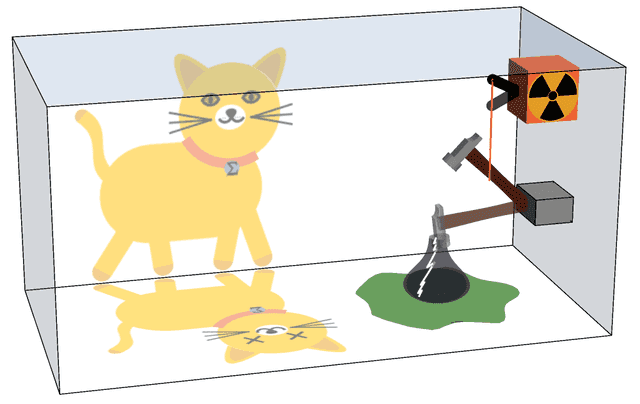
In the fascinating world of quantum physics, one question often pops up: What is Schrödinger’s cat? In 1935, Austrian physicist Erwin Schrödinger created one of the most iconic thought experiments in scientific history. This compelling paradox continues to stir debates in science, philosophy, and even pop culture nearly a century later. His goal was simple yet profound: to highlight the bizarre implications of quantum mechanics when applied beyond the microscopic world. However, what began as a critique of quantum theory has now evolved into a central symbol of quantum strangeness. How can something be alive and dead at the same time? How do probabilities define reality? In this article, we’ll dive deep into the origins of Schrödinger’s famous cat, unpack the deeper meanings behind the paradox, examine its impact on science and popular culture, and explore what it means for the future of quantum mechanics and our understanding of reality itself.
The Birth of Schrödinger’s Cat: A Thought Experiment
To understand Schrödinger’s cat, we must return to the 1930s. Quantum mechanics had already revolutionised how scientists thought about particles at the most minute scales. Yet Schrödinger was deeply unsettled by what quantum theory seemed to imply: that particles exist in multiple states until observed.
In response, he imagined a hypothetical experiment. A cat is placed inside a steel box with a Geiger counter, a tiny bit of radioactive material, a vial of poison, and a hammer. If an atom of the radioactive material decays, the Geiger counter triggers the hammer to break the vial, releasing poison and killing the cat. If the atom does not decay, the cat lives. According to quantum theory, the atom exists in a superposition of decayed and undecayed states before the box is opened, meaning the cat must simultaneously be alive and dead.
Thus, Schrödinger highlighted the absurdity of applying quantum mechanics to everyday objects, revealing a paradox at the heart of modern physics.
Understanding Quantum Superposition and Entanglement
The central mystery behind Schrödinger’s cat’s meaning lies in the concepts of superposition and entanglement. In quantum mechanics, particles don’t have definite states until they are measured. Instead, they exist in a “superposition” of all possible states. The radioactive atom is both decayed and not decayed; thus, the cat is dead and alive.
Entanglement, another fundamental quantum phenomenon, describes how particles can become linked so that the state of one instantly influences the state of another, no matter the distance between them. Schrödinger coined the term “entanglement” while explaining his cat paradox, emphasising that once particles interact, they must be described as a unified system rather than individually.
These concepts challenge our classical understanding of reality, suggesting that at the deepest level, the universe is governed not by certainties but by probabilities.
What Schrödinger Meant
Contrary to popular belief, Schrödinger did not propose his cat thought experiment to promote the superposition idea. He intended it as a critique of quantum mechanics’ interpretation. He wanted to show the ridiculousness of assuming that quantum behaviour could simply scale up to macroscopic objects without consequences.
For Schrödinger, it was logically impossible for a cat to be dead and alive. His thought experiment revealed that quantum mechanics might be incomplete—or at least improperly interpreted—regarding larger systems.
From Schrödinger’s Cat to Pop Culture Fame
Today, the thought experiment has taken on a life of its own. The phrase “Schrödinger’s cat” pops up everywhere—from science classrooms to internet memes. It resonates because it captures the strange and counterintuitive nature of quantum mechanics in a way anyone can appreciate.
The famous “schrodinger’s cat meme” often humorously depicts the cat as sarcastically commenting on its ambiguous state, while science fiction explores the idea of parallel realities where different outcomes coexist.
Moreover, the thought experiment has inspired TV shows, films, novels, and music. From “The Big Bang Theory” to “Dark Matter,” popular culture has eagerly embraced the cat as a metaphor for uncertainty, multiple possibilities, and the complexity of choice.
Quantum Mechanics and the Problem of Measurement
The Schrödinger’s cat paradox exposes what physicists call the “measurement problem”—how and why quantum possibilities reduce to a single reality upon observation.
One solution, the Copenhagen interpretation, claims that the act of measurement causes the collapse of the wavefunction, resolving the superposition into one outcome. In this view, reality itself depends on observation.
But critics argue that this explanation seems unscientific. After all, why should mere observation have such profound physical consequences? Shouldn’t there be a more objective process at work?
The Many-Worlds Interpretation: Every Outcome Happens
An alternative theory emerged in the 1950s: the Many-Worlds Interpretation, proposed by Hugh Everett III. According to this view, every possible outcome occurs in a different universe branch. When you open the box, one version of you sees a dead cat, and another version sees a live cat.
Thus, the cat is never alive and dead in one universe; instead, the universe splits into parallel realities. This interpretation elegantly solves the measurement problem without invoking mysterious collapses, but it introduces the mind-bending idea of a potentially infinite number of universes.
Schrödinger Cat Experiments in the Modern World
While the original thought experiment involved a hypothetical cat, advances in quantum technologies have enabled scientists to create real-world analogues.
Experiments have successfully placed photons, atoms, and even larger molecules into superposition states. Researchers have even engineered tiny mechanical resonators—macroscopic objects containing billions of atoms—to exhibit quantum behaviour under certain conditions.
Such experiments bring us closer to whether quantum weirdness applies at all scales or whether a fundamental boundary separates the quantum world from the classical world.
Schrödinger Cat in Hellsing and Fiction
Beyond science, “schrodinger cat hellsing” refers to a character in the anime “Hellsing Ultimate,” who embodies the paradox of Schrödinger’s cat. Able to exist everywhere and nowhere, the character is a literal representation of quantum uncertainty and superposition.
This creative adaptation demonstrates how Schrödinger’s original idea inspires narratives that blend science, philosophy, and imagination.
What If We Are All Schrödinger’s Cats?
The philosophical implications of Schrödinger’s cat extend far beyond a trapped feline. Some interpretations suggest that conscious observers might exist in a superposition of states until they experience an outcome. This ties into more profound questions about the role of consciousness in shaping reality.
Are we, in some sense, quantum beings, constantly collapsing wavefunctions through our perceptions and choices? If so, our understanding of free will, determinism, and the nature of existence could require a radical overhaul.
Quantum Computing and the Legacy of Schrödinger’s Cat
One of the most exciting developments in modern science is quantum computing. Quantum computers leverage the principle of superposition to perform calculations that would be impossible for classical computers.
In a way, the qubits in a quantum computer are like mini Schrödinger cats, existing in multiple states at once until measured. Pursuing stable, error-free quantum computation hinges on mastering these delicate superpositions.
Thus, Schrödinger’s playful critique may enable some of humanity’s groundbreaking technologies.
Modern Theories: Is There a Middle Ground?
Not all scientists accept either the Copenhagen or Many-Worlds interpretations. Some propose that quantum mechanics is incomplete, requiring hidden variables to explain apparent randomness.
Others suggest that quantum superpositions collapse spontaneously without observation due to objective mechanisms, like gravity. These “collapse theories” aim to explain why macroscopic objects don’t usually display quantum weirdness without needing human observers.
If proven, such theories would resolve Schrödinger’s cat paradox while preserving realism—a goal that Schrödinger and Einstein would likely have applauded.
Schrödinger’s Cat and Humanity’s Desire for Certainty
At its heart, the enduring appeal of Schrödinger’s cat lies in its challenge to human intuitions. We crave certainty and more precise outcomes. Yet quantum mechanics suggests that uncertainty is not just a flaw in our knowledge but a fundamental aspect of reality.
In contemplating the cat, we confront the unsettling possibility that the universe is far stranger and less deterministic than we ever imagined. It invites us to rethink what it means to “know” something.
Conclusion: The Future of Quantum Physics and Schrödinger’s Cat
So, where does all of this leave us? Even after decades of debate, Schrödinger’s famous cat remains at the centre of quantum mysteries. The question of what Schrödinger’s cat is continues to provoke inquiry into the very fabric of reality.
As quantum technologies advance, from computing to teleportation experiments, the need for a deeper understanding of quantum mechanics grows more urgent. Whether through new interpretations, innovative experiments, or even philosophical breakthroughs, the quest to resolve the paradox lives on.
Ultimately, Schrödinger’s cat challenges us to embrace uncertainty, rethink reality, and recognise that the universe may be far more prosperous—and stranger—than our wildest imaginations.