
Many students believe that reading slowly leads to better understanding. In practice, the opposite is often true. Slow reading frequently invites distraction, boredom, and fragmented comprehension. Instead of absorbing meaning, readers become overly focused on the mechanics of reading itself.
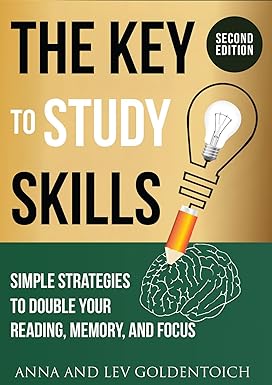
In The Key to Study Skills (2nd Edition): Simple Strategies to Double Your Reading, Memory, and Focus, reading is reframed as an active, high-focus process, one that benefits from speed rather than suffering from it. One of the most effective techniques presented in the book is metaguiding, a structured approach to maintaining a fast, controlled reading pace that improves both comprehension and concentration.
This article explains how metaguiding works, why faster reading can lead to deeper understanding, and how to apply the technique correctly within a complete study system.
Why Faster Reading Improves Understanding
Reading at a constant, fast pace is not about rushing through text. It is about removing the mental space that allows distraction and overanalysis to take over. When speed is controlled correctly, reading becomes more focused, more engaging, and more coherent.
Focus Shifts From “How” to “What”
A common reading problem is excessive attention to the reading process itself, tracking eye movements, obsessing over markers, or second-guessing comprehension. When reading speed increases, this internal monitoring disappears.
At higher speeds:
- There is no time to fixate on technique.
- Attention naturally shifts to meaning.
- The brain generates the appropriate markers automatically.
This shift allows comprehension to emerge naturally, rather than being forced.
Faster Reading Preserves Logical Flow
Slow reading often leads to rereading small chunks of text repeatedly. While this may feel productive, it frequently breaks the logical chain of arguments within a paragraph or section.
When reading faster:
- Rereading happens only when comprehension truly fails.
- Larger chunks of text are processed as coherent units.
- The structure and intent of the text become clearer.
This preserves meaning rather than fragmenting it.
Speed Prevents Boredom and Mind-Wandering
Boredom is one of the greatest enemies of focus. When reading slowly, attention drifts easily into daydreaming. Increasing speed introduces urgency, which keeps the mind alert.
Reading against the clock creates:
- Mild cognitive pressure
- Heightened alertness
- Sustained engagement
This controlled urgency is essential for maintaining concentration over long reading sessions.
Metaguiding: A Simple Tool With Powerful Effects
Metaguiding is a speed-reading technique designed to force the eyes to move faster than their habitual pace. It revives a natural behavior many people used as children, guiding reading with a finger, but applies it more strategically.
How Metaguiding Works
Instead of placing a finger under each word, metaguiding uses a finger (or another guide) to track each line of text. The key difference is intention.
- The finger moves at a steady pace.
- The eyes are forced to keep up with the finger.
- The reader does not slow the finger to match comfort.
This reversal is critical. Rather than guiding reading with the eyes, the eyes are trained to follow an external rhythm.
Why It Prevents Rereading
Rereading often happens unconsciously. The eyes drift backward to “check” something that feels unclear. Metaguiding removes this option.
Because the finger keeps moving:
- Backward eye movements become difficult.
- The reader stays oriented forward.
- Comprehension becomes continuous rather than repetitive.
The effort required to keep up with the guide keeps attention anchored in the present line.
When Metaguiding Works Best
Metaguiding is most effective under specific conditions. These conditions are not limitations but assumptions that apply to most everyday reading tasks.
The technique assumes:
- Key names, dates, and dense information were encoded during prereading.
- The text is of average density and cannot be skipped.
- The material builds on prior knowledge.
- Deep analysis is not required during the reading phase.
Under these conditions, which apply to the majority of textbooks, articles, and study materials, metaguiding is highly effective.
When these assumptions are met:
- Rereading is unnecessary.
- The focus shifts to generating markers.
- Speed and accuracy improve together.
Choosing a Metaguiding Device
The simplest metaguiding device is a finger. It is always available and easy to control. However, different readers may benefit from different tools depending on context and cognitive needs.
Common Metaguiding Options
- Finger: Ideal for most readers and printed texts.
- Card or sheet of paper: Especially helpful for readers with dyslexia or ADHD, as it blocks upcoming text and reduces visual overload.
- Continuous scrolling: Effective for digital reading, where motion replaces line tracking.
The goal is not the device itself, but the consistent forward motion it enforces.
Why Single-Word Flashing Tools Fall Short
Some speed-reading programs display one word at a time at a fixed speed. While appealing in theory, this approach has significant drawbacks.
These programs:
- Remove words from their context.
- Eliminate the reader’s ability to pause briefly.
- Create dependence on external tools that are not always available.
Programs that display multiple words at once are more effective, but metaguiding remains simpler and more adaptable across situations.
Controlling Speed Without Losing Comprehension
Metaguiding is not about maximum speed at all costs. It is about controlled speed, adjusted continuously based on comprehension.
How Fast Should the Guide Move?
The recommended approach is to move the finger at an almost constant pace, slightly faster than what feels comfortable.
In practice:
- The first paragraph of a page may be slightly slower to establish context.
- The last paragraph may slow down to ensure full-page comprehension.
- Headings naturally create brief pauses that help build section markers.
If comprehension drops noticeably, the guide should slow down. If comprehension remains strong, the guide can move faster.
Speed is not fixed; it is regulated moment by moment.
Metaguiding Within the Study Cycle
Metaguiding is not a standalone technique. It functions best as part of a preread–read–analyze cycle, where each phase has a distinct purpose.
The Three Phases
- Prereading
This phase prepares the mind by identifying structure, headings, key terms, and dense information. - Reading (Metaguiding)
This is where metaguiding is applied. The goal is fast, accurate reading with marker generation. - Analysis
After reading, the material is reviewed, connected, and integrated.
Metaguiding should only be used during the reading phase. Skipping prereading or analysis reduces its effectiveness.
A typical section for this cycle is about two to three pages.
Advanced Metaguiding for Experienced Readers
As reading speed increases, finger-based metaguiding may become inefficient. At advanced levels, rhythm replaces physical guidance.
Paging as a Metaguiding Rhythm
Instead of tracking lines, advanced readers use page turning to enforce pace.
- Pages are turned every 3 to 5 seconds.
- Digital devices often allow even faster rhythms.
- The page itself becomes the timing mechanism.
This approach works best for larger sections of around 20 pages and requires strong prereading and marker skills.
Why Metaguiding Works
At every stage, metaguiding serves a single purpose: maintaining a high, consistent reading speed that supports focus.
It:
- Reduces distraction
- Prevents unconscious rereading
- Preserves logical flow
- Keeps engagement high
Rather than fighting natural tendencies, metaguiding channels attention forward and makes sustained reading easier.
Conclusion
Reading effectively is not about slowing down; it is about staying engaged. Metaguiding offers a simple, practical way to increase reading speed while improving comprehension and focus.
By guiding the eyes forward, enforcing rhythm, and integrating reading into a structured study cycle, metaguiding transforms reading from a passive activity into an active cognitive process.
These strategies are explained in greater depth in The Key to Study Skills (2nd Edition): Simple Strategies to Double Your Reading, Memory, and Focus, alongside practical methods for memory, analysis, and long-term learning.
If you want to master these techniques step by step, explore the KeyToStudy: Memory Masterclass, where reading, memory, and focus strategies are taught as a complete system.
For course discounts or more information, contact info@keytostudy.com.
Effective reading is not about effort; it is about method.