
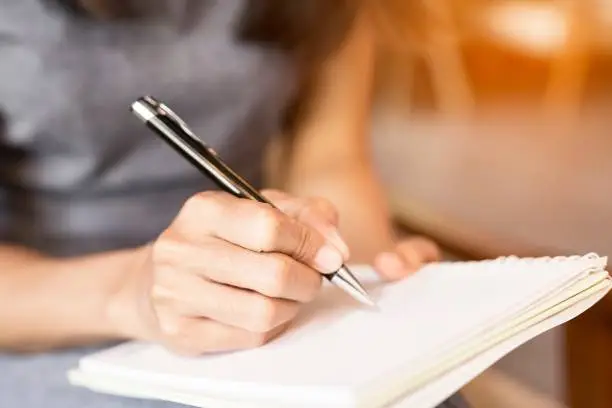
In a world revolving around devices and screens of digital text, no one would even think that the art of handwriting could get outdated and we would even forget how to do it. But that’s not how it is. While we live in an age of instant gratification and the demand for quick and easy, a revolution is taking place whereby artists, researchers, and intellectuals rebel against the digital way and want to go back to the basics of pen and paper to channel their creativity. It’s much more than just a throwback to a tradition—it’s a time-tested way to get to the wellsprings of our creativity and figure out new ways of creating memory, consolidating knowledge, and developing careful expression.
The procedure described here can help prose writers, students, and anyone who wishes to improve their cognitive skills get this feeling of control not only in the language they write in but also in their attitude. Think of a time you were writing with a pen handle on paper and then you recall a scene, the act of simply writing it down can transport you back in time, regenerate your awareness, and allow the creative abilities that you keep hidden to flow. The content of the article discusses the positive cognitive and creative aspects of longhand writing and the reasons why you should learn writing by hand to boost your creative abilities.
The Neuroscience Behind Longhand Creativity
The simple act of writing by hand involves various parts of the brain which would not even be slightly activated if we were typing. In the cognitive-nerdy world, it was found that handwriting awakens the sensorimotor cortex, the prefrontal cortex, and the hippocampus, which are all-important in processing emotion, retaining memory, and concentrating attention. This greater brain connectivity in turn causes better encoding of data making it more comprehensible and memorable, which is why handwriters process and save information better compared to computer writers.
There are many differences between typing and writing longhand, the first being that the former is more mechanical and rather detached than the latter which is more immersive and thought-provoking. Writers are allowed to be creative and develop their minds through the ability to mold each letter of the text intentionally. One of the indirect benefits of longhand writing, or the art of shaping every single letter on the page by hand, is that it forces individuals to slow down and process information on a deeper level of understanding.
Cognitive Benefits: Memory, Focus, and Reflection
Furthermore, writing longhand not only liberates creativity but also improves other brain functions such as memory and focus. In an illustrative experiment carried out jointly by Princeton University and UCLA, for instance, handwritten note-takers who scribbled blue and red ink on paper fared better than their typed note-taking peers in factual recall and mental performance tests. Why? The immediacy of typing results in verbatim notes, taking away the possibility of organizing the content and memorizing it. On the contrary, we have to consume it, find its significance, and then articulate it in our expressions, which means the last is the most effective.
It also adds a layer of augmented reality which gets itselfrecovery from these conditions. Digital devices such as desktops, laptops, smartphones, and other devices send too many notifications, pop-ups, and other unnecessary information which are so distracting that the brain cannot focus on something more important losing the opportunity to reach the recognitional threshold. The pure magic of this ever-living time of zones, that time of deep work, where cognitive output is at its height, awakens the mind and cleanses it of its extensions by which we distract it from the task.
Writing Longhand and Emotional Connectivity
-Ersin
Many authors have highlighted the fact that they feel more emotionally connected to their texts if they write in cursive. The physical act—the sound of the pen on the paper and the need to adjust the tempo of the hand so that it can keep up with the brain—brings the author and the words close enough to each other to create an emotional bridge. That bridge is footsteps to the bridge of a man that needs to describe characters, show vulnerability, or point out the subtleties in the theme.
This event is to a large degree the result of haptic feedback that writing provides. The physical sense experiences moving, ink flowing, and paper wrinkling, the more you are sensory aware, the more you are emotionally engrossed in it. As predicted, it’s the case with most poets, novelists, and songwriters when they have emotionally loaded material to write, they often prefer longhand. The connection made with the reader dances into new forms of freedom, and their lyrical ideas flow profusely.
The Messy Beauty of First Drafts
While typing, a well-structured text on the lighted screen gives an impression of a flawless piece of art. Creativity is not linear. The first draft should be imperfect, up for interpretation, and full of mistakes. The beauty of writing longhand is being able to embrace these imperfections. The scribbles, the crossed-out words, the arrows, and marginal notes—they become part of the story’s evolution; they are the journey of creativity in motion. This tangibility also harbors the story’s content since the process doesn’t respect traditional connections and operates on a different axis.
Also, when editing a handwritten text page, you should be more cautious about erasing good ideas too quickly. The over-editing of typed drafts is one of the disadvantages of digitalization since the tools help to change or delete a whole draft in just seconds. On paper, the process is more laborious and that is the main reason for not editing too quickly; however, over some time this process can not only be the practice of a writer but can be the exercise of ideamonger as well. It constantly leads the writer to contemplate a great number of conjectures so that, in the end, he/she keeps the one that proves to be the best by letting his/her thoughts develop organically.
Enhanced Creativity Through Constraints
To be more specific, it is through the limitations of the longhand writing skills–which are slow, require effort, and have limited space–that it can refine the creativity of a person. These restrictions force the brain to get more resourceful. Article writers are required to pay more attention to the words, the structure, and the content of their work. This fact that writers pay more attention often leads to clearer and, thus, more powerful, prose.
A study from Frontiers in Psychology found that traditional ways of creation, like handwriting and sketching are some of the activities activating the default mode network in the brain. The default mode network is connected to daydreaming, imagination, and introspection which are essential elements for making your thinking creative. Just doing the simple act of writing by hand rather than by keyboard might bring about a more profound and fertile creative state and thus make you happy.
Writing Longhand as a Meditative Practice
Several people describe writing longhand as a meditative process. There is a calming rhythm in the hand’s movement and the ink’s flow which can reduce anxiety and help a person’s mind to be quiet. Actually, some therapists suggest that one should journal by hand in order to process emotions and cope with stress.
Typing, in contrast to this, is a quick task that you must finish as soon as possible. Handwriting, in turn, ensures the presence of the writer. You are engaged with the topic on all three levels, namely, the mental, the emotional, and the physical. This interactive approach to writing makes the writing activity more immersive and, as a result, more rewarding. Throughout the years, the practice can build the skills of mindfulness, patience, meditation, and a closer relationship with your thoughts.
Writing Longhand in the Digital Age
It may seem counterintuitive, but analog activities such as writing longhand are on the rise even in our hyper-digital era. Complex notes, a community of ink-written-lovers, and the aforementioned low-tech but highly productive methods which have found an enthusiastic following, consistently and almost exclusively, especially among the youngest generations, have emerged. Most of the time, the noisy environment of the real world, is one big headache that is needed to be dealt with. There is so much noise from the screens and digital overload everyone is experiencing.
On the other hand, digital tools are indispensable too. The critical thing about digital media is that is it great for editing, storing, and sharing big ideas. At the same time, nowadays, creative people do not shy away from having their creative space in analog—writing down not just first drafts but also outlines and even idea drawings for a later medium to further refine. The middle ground is a fusion of the two that is the best option allowing writers to write, which is a skill, and at the same time yield the comfort of digital devices.
The Left Brain, Right Brain Myth—and the Truth About Creativity
An argument against the writing of longhand is the supposed limitation of emotional expression due to hemisphere dominance. The logic is that if the left brain rules the right hand, and emotions reside on the right side of the brain, then the writing hand restricts the depth of emotion. However, modern neuroscience has debunked this left-brain/right-brain dichotomy. Creative work is a dominance of the entire brain.
A study by Nielsen and Zielinski in 2013 demonstrated that creative and analytical thinking are not restricted to a single hemisphere of the brain but are spread across the brain networks. Another observation is that Dr. Alice Flaherty discovered the frontal lobes, temporal lobes, and limbic system, which are the same areas active during emotional and linguistic tasks. This means that the whole brain takes part in writing longhand.
The Renaissance of Analog Tools
Opposite the rebirth in penmanship is an advancing appreciation of the tools themselves. Fountain pens, fine stationery, and Moleskine notebooks are no longer outmoded items; they are the basics for a fast-growing group of analog enthusiasts. Those objects deliver tangible pleasures unattainable digitally; like the feeling of textured paper, the sound of the nib moving on the surface, and the ink’s gentle spread. Such interaction of the senses can make one enjoy the writing process more. It does not only become a task to accomplish but also a ritual to perform.
Writers usually refer to their tools as parts of their minds. The tactile joy of using a preferred pen or notebook can become part of the creative process with its multi-layeredness of meanings and intentions. Therefore, the items that we use for writing serve as co-creators in the process of expression.
Writing Longhand in Education and Professional Life
Although the use of typewriters in educational institutions and workplaces is widespread, there is still a recognition of manual writing as an effective tool for both education and the professional world. Some schools are starting to teach cursive not just for nostalgia’s sake but because research has found that it improves literacy, motor coordination, and cognitive development.
Handwriting has helped professional people in better brainstorming sessions, meeting engagement as well as in creating new ideas. With participants capturing spontaneous thoughts in a quick sketch, handwritten mind map, or a visual note, the way of expressing thought through handwriting may sometimes be the medium of the ideas that were overlooked. Another big advantage of writing by hand is that the personal touch it brings—be it in thank-you cards, letters, or annotations—remains in the digital world.
Longhand as Legacy
In addition, there is a strong element of human presence when someone writes something by hand. The typed pages are pretty easy to reproduce; they are stored in clouds, and it is quite common to lose them in inboxes. Unlike typed ones, handwritten papers are the witnesses of time—smears, spots, several folds, and handwriting styles are all additional commentary beyond the content. The reasons are hand-edited recordings, letters, and manuscripts bringing history to life which was once an oral, easily forgotten one.
During the manuscript’s composition, writers can reflect their emotions through the archives they create. An erased sentence, a margin sketch, and a messy arrow connecting the scenes are the very ways the struggle and the triumph of the creative process are preserved. Mann and woman formalize the philosophy: no fine clothes, no polished stories, both were once a roughened attitude of the one having written by the hand in searching for meaning.
The Final Words
The key to writing longhand is not the rejection of the technology; instead, it is the opposite of that: to grab back the side of humanity that technology cannot imitate. It’s time to do things more thoughtfully, to take more time for feeling, and to derive sustenance from getting in touch with the creative purpose. This process helps in the way through which we find not only the words we want to use but also our innermost selves.
Away from all the crowd and worries with the immediacy of modern times, it is in the longhand-writing genre we find peace and quietness when needed, time for thought, and helpfulness for the creativity that comes with it as well. Whether you’re a writer looking to rekindle your inspiration, a student wanting to retain more, or a professional craving deeper engagement, picking up a pen might just be your best next move.
At first glance, we might consider handwriting a thing of the past, but it is hardly so. In reality, this is an eternal accessory that always stands for the same thing which is the prevention of Alzheimer’s disease through brain and brain connections.
For many creative people, writing longhand must often seem to have been endowed with a certain perfection. It is not a mere writing technique, it is a lifestyle- a journey into the depth in times when society focuses mainly on the surface, an act of returning to your presence in a world of constant distraction. Longhand writing may be the slowest form to get your writing on paper, but it is also the fastest way to pinpoint the important words.