
Our world quickly becomes digital. Should we still use pens? If so, which pens and how. Do pens actually help productivity? Are they going to stay with us in the future? What about paper? Do we need paper too? How should we use it?
Paperless office
The premise for computerization was a paperless office. Half a century later, we still use plenty of pens and plenty of paper in any office. Probably more than ever. What happened? Was the original idea bad? Are the clerks too slow to adapt?
Paper copies are often used for accounting and legal documents, often signed by the parties. In the age of digital signatures, a physical signature is still required on some real estate deals. Other than that, the electronic submission slowly suppresses the physical documents. The process is slow, it takes decades, but the regulators are finally fine with digital signing.
Executives are also fine with electronic documents. 20 years ago, executives would print out the important documents and add comments on the printed form. Now they just annotate documents in MsWord or Google docs. The generation that needed printed documents to think is near retiring.
Even the bills and letters from financial institutions are now sent in digital format.
So, who uses the paper and why?
Children, open your notebooks
Children and students still write, quite a lot, in many classes and lectures. Most of them hate it. They feel better printing on a keyboard. Yet when they sit in a class in front of a teacher, they copy from the whiteboard and write down the important things the teacher says.
In conference rooms and universities, some people type while some people write on paper. It is profoundly easier to bring a paper block and a pen, than to take care of a laptop with its cables and charging.
It is also easier to doodle on paper when we are bored. To be honest, I feel equally comfortable doodling on the computer, but then I use a very different sort of doodling.
Job interviews are still done with pen and paper. Even programming interviews. I do not really know why. It feels strange.
So when we feel like learning, we usually use pen and paper.
Diagrams
We write professional diagrams using tools like Visio, or maybe Powerpoints. Maybe we use Blender or Autocad. The thing is: the professional software requires us to know quite well what we are trying to do. Brainstorming with software is not very convenient. So for brainstorming, like drawing mindmaps, diagrams, flowcharts, and drafts – we use pen and paper. They are crude, but they are also very fast.
Usually, when I brainstorm with pen and paper, I come up with ideas I do not get near a computer. And vice versa. Maybe when we use a different environment we activate different associations. Anyway, it is a nice complementary strategy. Highly recommended.
Personally, for this, I prefer Parker Jotter or bolt action pens and cheap graph paper
Retro
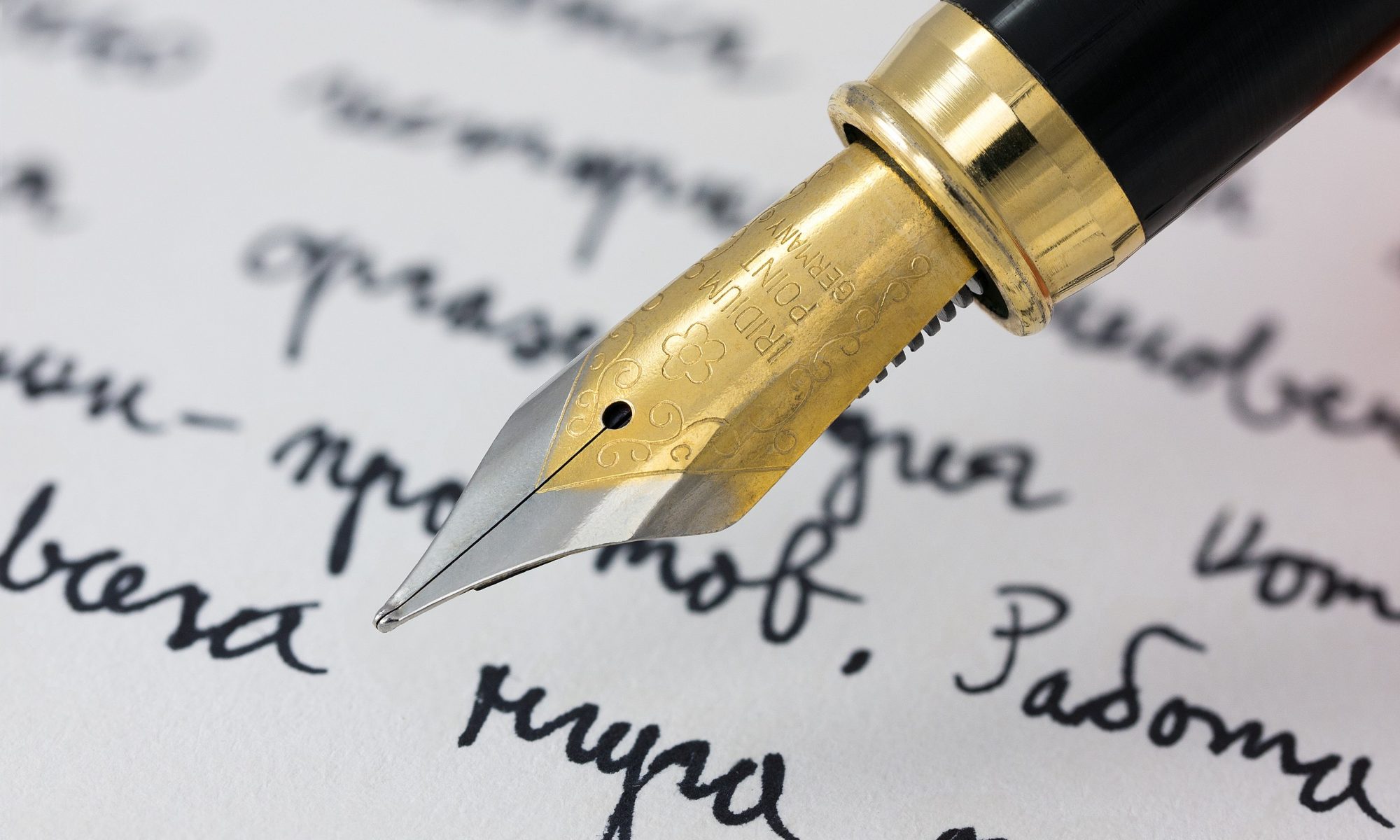
There is something very retro writing with a fountain pen on quality paper ruled paper. Even when what we say is not very smart, it feels important.
When combining information from multiple devices and sources, this is a nice approach. It focuses on the target. A heavy pen adds focus to the activity itself, and does not allow to defocus.
A hundred years ago people had plenty of time to write everything they wanted. They used quality paper and fountain pens and complex ways to say simple things. Occasionally we want and need it, for example for creative writing. We simply generate different text this way.
Doodling
Usually, with a mechanical pencil and paper we take from the printer.
When doodling we come up with various visual ideas. The process is profoundly nonlinear with unexpected twists and turns. We do not want to be confined by media. A heavy mechanical pencil provides very fine motion and very fine pressure on the paper. If we regret it, we can easily use an eraser.
Playing with the pressure on the pencil we can provide shading.
This sort of doodling is great for ideas we have for physical objects, photographic compositions, visuals for presentations, design, and branding.
Print out and use markers
When using markers and highlighters it is often faster to highlight text and add comments on the margins in printed format. The required coordination is simply easier to achieve than the annotation of computerized documents. This allows faster processing.
The printing itself is usually done on huge office printers, so it is not a limitation.
People often do this with books, printing one section each time, or with their own documents when editing. Simply seeing the document in another format facilitates the generation of new ideas and editing.
This format is also comfortable for lying in bed or half-lying on a sofa. Not something we can easily do with any mobile device. I had carpal tunnel pain from trying to simulate the effect with iPad air and a stylus pen.
Handwriting on a touch screen
Using a stylus pen and handwriting or doodling on a touch screen of a large ipad is fast and comfortable. It can often replace the pen and paper experience. All the results can be stored for further reference, and uploaded. No need to keep somewhere many pounds of used paper.
There are some limitations too. Most of the commercially available stylus pens are very small and lightweight. This is uncomfortable for a healthy male like me.
A tablet is much heavier than most of the paper blocks we use, which is a limitation for working without a desk, say outdoors.
And the result needs to be exported into PDF and sent by email if someone else wants to work with it. This is a bit harder than put it in a copying machine.
So I still prefer pen and paper, thank you.
3D pen
I honestly tried to use a 3D pen to draw stuff. I was not successful. The patience required to add small lines to the object layer by layer is not for me. It is easier to use design software and 3D printer for the same purpose.
For kids the situation is different. Drawing a very simple wireframe outline of a dog or a cat is easy. Then the object can be used in a sort of home theater, doing stuff. And after use, it can be easily disposed of.
A paper in this scenario is a nice substrate. If there is an outline on the paper, it is easy to copy it repeatedly with a 3D pen. We print a readily available downloadable. Add some small modifications with a pencil. And from that point on, we can easily copy the object.
Libraries
I kind of stopped using paper books, unless I want a special treat or get a gift. I brought a hundred of my books to my parents. My father threw 2000 volumes from his library since he switched to electronic books.
Yet my library is still full of stuff. How come?
Our accountant is giving us old receipts in binders. The receipts should be kept for 7 years. They are not electronic, since the baker or the butcher does not generate electronic receipts.
At the same time, I am getting many boxes of cables for my digital devices: USB, HDMI, Lightning (iOS), USB-C (Android), headphones, and more. We love to hold our devices and work with them while they are charging. So cables break, and chargers fill my storage spaces.
So books and notebooks are slowly leaving our libraries, being replaced by various stuff… Even in the city libraries, books are often replaced by all sorts of gadgets and models.
Who is using all this paper?
Why do we use more paper? Apparently more people work in the office. People make more documents. Even if 90% of these documents most of the time are used electronically, 10% are printed. And these “10%” are a lot. Probably, in less computerized societies, documents are still being processed the old-fashioned way.