
The mind’s ability to keep in one place a piece of data has been in the past viewed as an unbending quality, immune to any possible upgrades—the so-called myth. The power of our memory is not constant–it is capable of being cultivated, reinforced (with repetitive training), and, with appropriate tools, completely transformed. “the wrap memory strategy” is one of the most popular tools for improving the memory A simple yet effective way to improve memory is through the “wrap memory strategy.” It is a straightforward and research-based technique the individual can use in their lives to remember necessary information more effectively, especially adults. You are either a person who is undergoing cognitive rehabilitation, dealing with someone with memory problems, or merely trying to improve your focus and retention at work. The strategy of putting major emphasis on such an issue can work at many different levels because it provides alternating levels of difficulty that can find the user at any level.
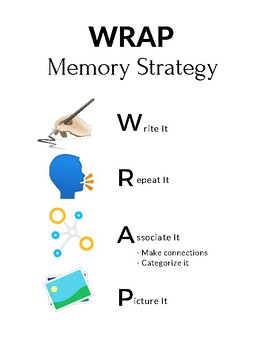
The “WRAP” explained: Write it down, Repetition and routines, Association, and picture it. Each is a strategy that represents the components of the memory-enhancing process wheel. What differentiates this approach is its seamless incorporation into daily routines, making it one of the best memory strategies that is suitable for all people in almost any situation. Herein, the readers will get an opportunity to know more about the components of WRAP strategy, its application in real life, and how it is practically effective through scientific investigations.
Why Writing It Down Works Wonders for Memory
Now, let’s switch to the first point, which is “Write it down.”, to handle this issue. This very tiny step is looking face in the most worldly, yet it has crucial changes in our neurological system. The neurons in the brain become active when people use them to write which include the motor cortex, language processing centers, and memory-related regions such as the hippocampus. Physical drawing has the effect of making information important and adding it to the brain’s memory for a longer period.
Compared to conveying information orally or by typewriting, the process of writing activates the tactile memory and spatial memory. This process may include remembering precisely where on a page you wrote a grocery item or the time of your appointment. It is especially helpful for adults dealing with mild cognitive decline and attention problems. Preparing written reminders by the use of sticky notes, journals, or digital note-taking tools, as well as the utilization of digital note-taking tools, serve as tangible backup systems that consolidate memory and support independence.
Furthermore, in “speech therapy memory activities for adults,” writing exercises are often the underlying ones. They enable individuals to slow down, to process information more deeply, and to develop methods for tracking tasks and events independently.
Repetition and Routines: The Brain’s Favorite Workout
The repetition of information is not only important for children learning multiplication timestables, but also for adults as well who have a powerful reinforcement tool. The “R” in the wrap memory strategy stands for “Repetition and routines,” and the more consistent you are, the better your chances of success are.
Regarding motor skills repetition of actions, for example, doing the same activity within a specific schedule, whether at home or school, can also lead to them becoming automatic. This helps in decongesting the brain of learning, thus enabling the new information to enter with ease. An example of this is the key holder rack, ensuring that your car keys are in one place every time you enter the house. In time, this will become automatic, and you will not have to suffer any confusion from it.
For instance, repetitive behaviors are a dimension of performance. Role playing and practicing, being clear about how the morning routine will be performed before it is done, can pave the way for the brain to have multiple opportunities to internalize the story and thus be able to recall it. A great number of strategies, among them the down time of repetition used in clinical or educational settings, aim to the distributed repetition, which is the method used of revisiting information at strategic intervals. This process adds strength to the neural circuits that emit the blaze of that memor,y and thus it is easy to carry the information over from the short-term storage to long-term storage.
Please find the revised content below:
Association: Building Bridges Between Memories
The wrap memory strategy’s “A” is for Association, a significant method that combines new data with the old one. If we associate a new piece of information with a familiar thing then our brain is provided with an easier way to retrieve that information the next time we need it.
Those associations are practically visual, auditory, emotional, and even scent-based. For instance, picturing a Rose in your mind becomes getting the right person if you get confused with the flower. Apart from that, joining new learning to songs, rhymes, or mnemonic devices helps turn the dull memory exercises into exciting events.
One of the most practical uses of this method is in constructing memory chains. Let’s say you’re trying to memorize a grocery list. Instead of listing items, you may create a mental movie: you are at a zoo, having fun with the elephants while drinking milk from your rucksack. Stupid? Yes. Still, it works effectively. Often, the more bizarre the association, the more it will keep you from forgetting.
This strategy is frequently used in the field of compensatory techniques aimed at memory across educational, therapeutic, and personal growth areas. It gives a creative and flexible approach to encoding and extracting memories.
Picture It: Unlocking the Visual Power of the Brain
Rewrite it, or better to say visualize it—the final step of the wrap memory strategy—is a way to invite mental synthesis of redoubtable mentalistic capacity. In all these processes, the attention control is the common denominator. Specifically, our brains are primarily visual, and transmit images much quicker than writing. By rehearsing a mental picture of what we want to retain, the brain activates the occipital lobe and the visual memory networks.
For example, if you want to remember a list of things you should do, you might as well feel like you are doing the tasks by imagining going through them. Imagine you are walking your dog, going to the pharmacy, or paying your bills after you see the mental film you have created. The more colorful and concrete the mental representation, the stronger the memory. This technique is frequently employed in the memory palace or the method of loci—both of these methods are used to memorize facts, and you mentally put objects on your mind’s path as you walk.
Another way of the effectiveness of “strategies for memory Speech Therapy” is visualization therapy for those in rehabilitation or with dementia. By encouraging the involvement of several senses through visualization, a more lasting neural adherence is given to the memory.
Integrating WRAP into Daily Life
The charm of the wrap memory strategy is in its practicality. No tools that are expensive or complicated systems are required. One can practice every component—Write, Repeat, Associate, Picture—using their existing patterns. You may follow this way:
- Write it Down: You can carry a small notebook in your pocket and use the said space for writing down ideas, appointments, or priority tasks whenever they cross your mind.
- Repetition and Routine: Determine specific spots where they are habitually forgotten and preset things there. Establish a morning or an evening routine that includes your main daily actions in the order they are going to be executed.
- Association: Think of funny, customized roads for the names, dates, or duties that you have to accomplish. Use irrelevant things that you like most to make it more personal and memorable.
- Picture it: Picture what the person/place you are trying to recall is doing in a mental picture/scenario. Use exaggeration and craziness to make it impact your memory forever.
The initiation of different strategies is a versatile action. Whether a heavy-duty work project is being conducted, or a greasy brain is opposite, or you are guiding a person suffering from memory loss, the WRAP method is a trustworthy friend.
The Neuroscience Behind the WRAP Method
The wrap memory strategy is corroborated by scientific studies based on well-accepted evidence in the field of cognitive psychology. Writing concretizes learning, repetition solidifies the same, association is a clue to search, and visualization exaggerates the retentions. This concoction of diverse elements, a kind of blended multi-sensory memory, is a carefully cultivated memory that plants those multitude of sensory roots which ramify the brain to encodings, storage, and recollections.
Neuroscientists claim that activating other brain systems (motor, sensory, language, and spatial) while learning amplifies synaptic plasticity—adaptation and rewiring of the brain. WRAP engages the multiple memory networks enabling the information to last longer and be rightfully recorded.
Who Can Benefit from the WRAP Memory Strategy?
In a word, everyone. The WRAP memory strategy is adaptable and profoundly beneficial for:
- Adults who are either incapable of remembering because of old age, head injury, or a medical condition, or have issues with their memory as a result of such reasons.
- Students who want to enhance their information retention skills.
- Workers who have to handle a lot of tasks or who switch roles often.
- People who take care of those that have impaired thinking.
- Those who devise treatment programs for cognitive rehabilitation.
WRAP is a tool that, when applied by itself or as part of a cognitive training program, can promote autonomy, and diminish the feeling of anxiety related to memory lapses.
Practical Scenarios for Using (It) WRAP
For instance:
- At Work: Prepare a list of key meeting agenda points. Revise the task execution steps as you go along with onboarding. Pair team members’ names with certain characteristics or behaviors. Picture your procedure to become more productive.
- At Home: Utilize sticky notes to remember housework. Put the keys into a set basket daily. Link food items with a family story. Produce mental images of items listed on the shopping list as you walk through the store.
- In Therapy: Make some memory books with clients. Say the names and instructions in the same way every day. Make the associations using the client’s interests. Involve the client in visual journaling.
The original mixture of everyday life scenarios and a proven scientific base of WRAP elevates the latter to the universal notion, which is likely to become a temporary fix.
Matching WRAP with Other Memory Approaches
The wrap memory strategy is more successful, along with other cognitive tools. For example:
- In combination with calendar apps that send both visual and audio reminders.
- Use voice memos when you want to supplement a written note with an audio layer.
- In addition, make connections that have emotional significance to enhance the associations.
- Practice mindfulness by paying attention more, which is a key process to memory consolidation.
Health pros and caregivers typically recommend the adoption of WRAP together with symptoms of illness.
How WRAP Advances Long-Term Independence
Instead of methods based on the external worldview that assumes external support has to do with memory, the wrap memory strategy offers remedies that lead to” memory self-sufficiency in individuals. This in turn makes it possible for the individual to become more confident, consequently reducing his/her level of frustration and finally leading to long-term independence. As time goes on, many of the WRAP users state that they feel they are masters of their environment, being over and done with and thus won’t even need other people anymore.
It also transforms the perspective towards memory. Rather than seeing it as forgetfulness, the person discovers the problem solving component, that it can be treated by tools and consistence.
Challenges and How to Overcome Them
Every approach has its initial difficulties. With WRAP, the following are the most prevalent issues during application training:
- Consistency: At first, it is very common to omit the act of noting things down apart from other activities
- Creativity Block: Certain people may experience a setback in coming up with connections
- Visualization Difficulty: In fact, not all people can imagine things by using pictures
To conquer these problems, begin with the smallest things. Choose a letter from WRAP that predominates in your weaknesses when it is practiced each week. Employ visual aids such as templates, flashcards, or online software to create a lasting effect. After a while, the tool will become part of your daily work.
Teaching WRAP to Others
Educators, caregivers, and clinicians can open a wrap memory strategy by demonstrating practical applications, role-playing, and through real-life examples. Multimedia products like illustrated WRAP cards and video tutorials facilitate the knowledge and application of the concepts of flash cards, which engage students in various modes.
Not only young adults and teenagers but even older people would like to remember things with WRAP. Moms and dads can bring these exercises to life by implementing them in the home as well.
Final Thoughts on the Power of WRAP
WRAP memory strategy is not a mere retake of a memory device; it is a thought-through power-up mechanism for memory management as well as a self-help plan. Through involving a person’s different senses and memory paths, WRAP can help people strengthen their memory retention related to various things. By including the well-orchestrated assembling of factors such as recording of the most important details related to time and weaving reading with eccentric ad-libs, the WRAP system always acts a role of the provision of the memory aid.
Introducing this method into your life or the life of someone you support can lead to a vast improvement in the quality of day-to-day functioning. Albeit time may be required to become an adeptive, but the long-term benefits of greater independence and less frustration are the efforts.
It doesn’t matter if you are a clinician who is creating a cognitive program or a person managing the mental load of daily life, do not forget the healing effect of the wrap memory strategy that becomes the key to how we remember, act, and thrive.