
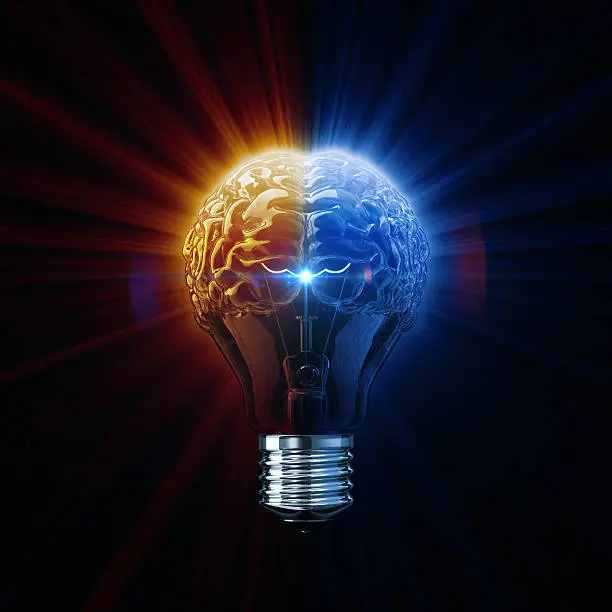
Have you ever been in a position where you’ve asked yourself, “What color is your brain”? Then, you must be going through the same thought process as I have numerous times. It’s a question that can be answered from the point of view of science, psychology, and even philosophy. Although it may seem an easy and clear question, the truth is more colorful—both literally and figuratively. The brain is the most intricate and misunderstood part of the human body. Although we often see it as pink in movies and textbooks, the actual color of the brain is influenced by its living condition, the amount of oxygen, the tissue composition, and the way the human eye and brain perceive the light.
When the human brain is in the state of living and moving, it’s not just looking like “the gray matter” or “the white matter.” It’s very colorably clear. The brain shines and glows due to the presence of a wide range of colors, such as brown, golden, and even navy blue. However, the aforementioned is nothing but a shallow description. The color of the brain inquires about the essence of how people visualize, process, and even sense color—not only in the surrounding world but also inside our minds. So, we all move forward into the realm of our brains with the question: which color is your brain and what does this color suppose about you?
The Physical Palette of the Human Brain
Much unlike the brain images that typical media is full of, the living human brain is far from monochrome. The surface of a brand-new brain, fully alive, shows a wet blend of light pinkish-grey matter, deep black shadows, and bright silvery white tissue. The colors of these components come from blood tubes called capillaries situated around the organ of the brain, the fat layer surrounding the nerves, as well as neurons and glial cells that together give a particular color to the brain…
In scientific terms, the human brain is composed of about 60% white matter and 40% gray matter. However, the term “what color is the brain” is not simply answered through the scientific beauty of these two terms. The part of the brain that houses the nerve fibers and is rich in the insulating myelin tissue, which makes the electric signals traffic at warp speed, is the white matter. No, it seems quite milky. The medial brain part, which is also known as the cortex, and that is very pinkish owing to the numerous blood vessels present, forms the gray matter.
In essence, “pink” is quite a misleading color to represent the brain in the minds of the living, while still being a very common image to your mind. This is the appearance when blood is richly oxygenated with the brain.
Brains and Emotions: Emotional Reactions to a Change in Brain Color
It might sound strange to you when people talking about what is the color of their brains in the context of personality or behavior instead of biology. It’s just the idea of “brain colors” which has been transformed by time into a symbolic language. Dr. Sheila Glazov’s “What Color Is Your Brain?” model of personality, for example, assigns colors to different behavioral types.
For instance:
- The color blue denotes those who are very emotional; they are very compassionate and empathetic.
- In the book of Sheila Glazov and her pages on different SM-, Green completely describes people with really scientific minds – they are highly logical, very much concentrated, and very much precise.
- Gold people always respect truth and order; they are well-organized and dependable.
- Orange people are very outgoing; in fact, they are very daring, and they get easily bored.
While they are not psychologically-based, these metaphors that model colors serve the people to understand themselves and leave positive relationships to others. In a social and psychological context, they visually represent a moving brain and its functions and describe it in a detailed way. These colours are abstract and will not use the bright hues of the brain in reality, but they will stimulate the emotional quotient and highlight the communication between people.
When Brains Are Alive: A Symphony of Color
Humans who have living brains have brains that are full of blood vessels. And this means that blood travels through the blood vessels to the brain to provide it with oxygen 24/7. Although it means red mixed with pinkish tissue and the white color from fatty myelin sheaths, the red color is seen when all three hues mix, the blood is oxygenated, and the brain cells are pinkish, which leads to a change in the brain color.
So, are brains pink? Yes and no.
As far as their color when they are alive go, yes, definitely they are pinkish gray as a result of the presence of oxygen-rich blood and tissue. But once the oxygen supply is cut off, the color will fade, and the brain will become brown. That is why in movies or preserved specimens, brains seem to be more gray, white, or even yellow. This is nothing but nature, not illusion.
Gray vs. White Matter: Two Sides of One Brain
Let’s explore the scientific specifics more accurately. Gray matter is a term given to the brain’s central area aimed at compiling and operating the information—home of neuron cell bodies. It is present both in the outer layer of the brain and in the clusters located deep within. White matter, on the other hand, contains axons (neurons’ long fibers) wrapped in myelin, a protein that speeds up communication between different parts of the brain.
The most interesting fact is how genders differ. It has been proven that men are physically and morphologically different from women as their brains have more gray matter and women have more white matter. This is particularly true for the frontal lobe. This means that despite both genders having the same intellectual abilities, they often find their solutions through distinct neurological pathways.
With this discovery, the question of what color your brain is becomes even more subtle. You see, the answer doesn’t stop at the physical but also spreads to the functional aspect. Brains are configured differently, and this wiring has consequences for thinking, feeling, and relating to others.
Optical Illusions and Color Constancy: Perceiving the Unseen
Have you ever come across the term color constancy? This is an in-built mechanism in the brain that allows us to understand that the object’s color remains the same even when light conditions change. One of the most famous instances of color constancy is a viral photo taken by Professor Akiyoshi Kitaoka. The “trick” here was that even though the image contained no red tones, people were assured the strawberries were red. Why? The brain would make the final decision ignoring the current input of the eyes and using the memory of the color and the expectation of the conclusion.
This demonstrates how our brains subjectively handle color information. Sometimes, we feel we are seeing a true picture of our surroundings when it is only our guess that is mainly steered by the experiences we have had in the past. The same case applies to brain color. If you are asked the color of the brain, you will think of pink, grey, or even blue- depending on your visual stimuli or learning.
These “tricks” of the mind are more of a feature than a fault. The human brain is a product of evolution and has been designed in such a way that it would operate in an efficient manner to comprehend and process information, even if this means we will be seeing unreal things at times.
The Dress that Divided the Internet
A related question on color perception: The Dress has added another mind-bending instance to color perception studies. The internet was literally torn apart by this phenomena in 2015 when a photo of a well-lit or shadowed dress was out. The public perceived the dress as white and gold, the other as blue and black when they divided into two groups. This inspired numerous responses dedicated to understanding the perception of color, learning that there is no common way in which our brains “see” color.
Scientists, for example, such as Pascal Wallisch went into the matter deeply to find out the reasons behind the split. His interpretation of the data led to the following result: the shade of the light in the picture the observer thought was there determined the color, either white and gold if the assumption was that the dress was not well-illuminated or blue and black if the assumption was that the dress was well-lit.
All these are indicating one thing: color is in the eye of the beholder. So, when we ask, What color is your brain, there might never be one universal answer because even color itself is up for debate.
From Frankenstein to Fact: Real Brain vs. Fiction
Most of us are acquainted with images of brains from science fiction movies and TV shows. These are usually according to the experiments in which the brain has been removed from the body and preserved in chemicals under a vacuum so that it is transformed to some colors like gray, white, and yellow. However, if we take the real case of a brain, in actuality, the living brain tissue appears soft and is full of moisture and resides in a delicate environment. The human race has advanced so much that even the term “human brain color” holds a variety of meanings, changing with time, variations in blood flow, and the different activities of life.
When preservation is carried out, the liveliness is removed and the tissues drained of their color, in the absence of oxygenated blood. What often takes place in dissection or in the anatomy lab is not the actual living color palette of the brain. It is like when you compare a picture of a sunset to the real thing while on the screen it is flat, and the other is a live presentation.
So… What Color Is Your Brain?
It starts to become a personal matter when you arrive at this point. ‘What color is your brain?’ someone might ask you. And you could scientifically respond as follows: ‘The living brain consists of various shades like pink, red, white, and black.’ Or you could decide to go for a metaphorical answer: ‘I am a red innovative person, a blue peaceful person, or a golden thinker.’ The truth is that both are the right answers.
This is the point at which brain color theories intersect with practical neuroscience. The color of your brain is not only related to the pigment but also the manner of its function, the mood it creates, and whether it matches the inner you. The structure of our brains is quite similar, but the way they work and the way we see them are up to us to decide.
Final Thoughts: The Ever-Changing Canvas of the Brain
This should bring us to a close. Let’s go back to the question we faced initially: What color is your brain?
At first, we studied the biological basis—white matter, gray matter, blood flow, myelin. In the middle, we went into the phenomena of illusions, how perception deceived us, and how our brains are deceitful and astonishing to us. Now, we come to the end and understand that the color of the brain is not a stationary fact of the brain but a relationship in control between body, mind, perception, and physiology.
The color of the brain is a matter of one’s choice as well. In the case of some of you considering your brain as a lively pink thinker, some others as an illustrative coloring to your personality, it is a matter of scene that will never cease to be interesting. When the discoveries of science probe deeper into the psyche, perhaps someday we will no longer wonder what color your brain is but why we perceive it in such a way.
Well, if someone faces you with the question about your brain’s color, now you may have a response that is as complex and deep as the question itself.
Of course, the question “what color is your brain” looks like a literal one but it really is a trip into the most profound part of a person’s identity, thought process, and the way of looking at the world.